
Can we find the gospel in every psalm? I believe so. The book of Psalms has 150 chapters, and we often find repeated themes and similar wording throughout. Some of these chapters are very short—Psalm 117 is only two verses! Two chapters later, however, we find the longest chapter in the Bible—Psalm 119, with 176 verses! No matter how long or short, every psalm has something to teach us about God and the gospel He has revealed in Jesus Christ.
In Psalm 7 we read again of David’s desire that the wicked be punished and the righteous vindicated. It’s introduced as a Shiggaion, sung to the Lord concerning Cush, a Benjamite. A Shiggaion is a type of Hebrew song described as a rambling poem or a wild, passionate song with rapid changes of rhythm. There’s no Cush in scripture who interacted with David, but one commentary says it could refer to Saul (of the tribe of Benjamin) or one of Saul’s people who caused mischief and ill will between him and David. Whoever he was, David felt passionately about the conflict between them and his desire for things to be set right.
I see three things in this psalm that remind me about the gospel.
#1 – The gospel teaches us to be humble about our own sins.
The first thing David does in this psalm is to offer his own heart for God to examine.
Psalm 7:3-5 – O Lord my God, if I have done this, if there is injustice in my hands, if I have rewarded evil to my friend, or have plundered him who without cause was my adversary, let the enemy pursue my soul and overtake it; and let him trample my life down to the ground and lay my glory in the dust. Selah.
Jesus affirms this attitude in His Sermon on the Mount in Matthew 7:2-5:
For in the way you judge, you will be judged; and by your standard of measure, it will be measured to you. Why do you look at the speck that is in your brother’s eye, but do not notice the log that is in your own eye? Or how can you say to your brother, ‘Let me take the speck out of your eye,’ and behold, the log is in your own eye? You hypocrite, first take the log out of your own eye, and then you will see clearly to take the speck out of your brother’s eye.
None of us are without sin (Romans 3:23). The gospel shows us our sins and draws us to kneel humbly at the cross first before accusing others of their sins.
#2 – The gospel teaches us about God’s amazing grace and patience for sinners.
As David enumerates the reasons for God to judge his enemies, he makes a strong statement by the inspiration of the Holy Spirit, revealing something about God’s character that we might tend to forget.
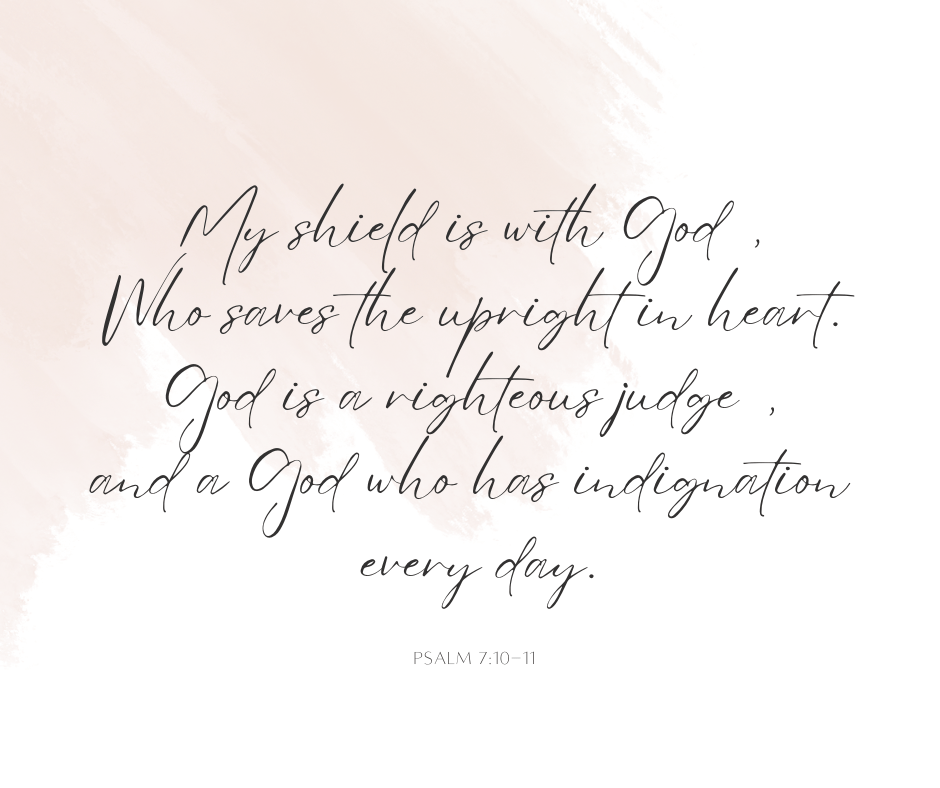
Psalm 7:11-12 – God is a righteous judge, and a God who has indignation every day. If a man does not repent, He will sharpen His sword; He has bent His bow and made it ready.
The KJV says, “God is angry with the wicked every day.” We don’t think enough about the wrath of God that resides on sinners and the depths of His grace and mercy that allow Him to hold back judgment to give time for repentance.
Matthew Henry comments on this verse:
That they are children of wrath. They are not to be envied, for God is angry with them, is angry with the wicked every day. They are every day doing that which is provoking to him, and he resents it, and treasures it up against the day of wrath. As his mercies are new every morning towards his people, so his anger is new every morning against the wicked, upon the fresh occasions given for it by their renewed transgressions. God is angry with the wicked even in the merriest and most prosperous of their days, even in the days of their devotion; for, if they be suffered to prosper, it is in wrath; if they pray, their very prayers are an abomination. The wrath of God abides upon them (Jn. 3:36) and continual additions are made to it.
David had experienced God’s mercy and grace, thus he could ask God to examine his own heart first. But he also knew that a terrible future awaits those who refuse to repent and instead, continue on in their wickedness. The gospel shows us God’s mercy and grace, as well as the depths of His wrath against sin—wrath that was poured out on His Son, Jesus, on the cross.
Romans 3:2-5 – But do you suppose this, O man, when you pass judgment on those who practice such things and do the same yourself, that you will escape the judgment of God? Or do you think lightly of the riches of His kindness and tolerance and patience, not knowing that the kindness of God leads you to repentance? But because of your stubbornness and unrepentant heart you are storing up wrath for yourself in the day of wrath and revelation of the righteous judgment of God.
#3 – The gospel teaches us that God’s judgment is just.
Is it fair for God to condemn the wicked?
Psalm 7:14-16 – Behold, he travails with wickedness, and he conceives mischief and brings forth falsehood. He has dug a pit and hollowed it out, and has fallen into the hole which he made. His mischief will return upon his own head, and his violence will descend upon his own pate [head].
The gospel offers an alternative to suffering the consequences of our sins. Those who refuse the mercy and grace of God by repenting and turning away from sin to follow Jesus are justly rewarded with the work of their own hands. God will not strive with us forever. We all will stand before God and give account for our lives. Those who accept the payment Jesus made on our behalf will be saved. Those who scorn God’s Son will receive the just payment for their sin.
God’s character never changes. He is perfectly and infinitely merciful and full of grace. And He is perfectly and infinitely wrathful against sin. David cast all his hope in God, trusting the Righteous Judge to do what is right. And that is the heart of the gospel.
Psalm 7:9 – O let the evil of the wicked come to an end, but establish the righteous; for the righteous God tries the hearts and minds. My shield is with God, who saves the upright in heart.
 The Way Of The Word