
Have you ever seen one of those pictures with the caption “What is it?” The more you look, the harder it becomes to figure it out. Why? Because either it’s zoomed in as much as possible, or you are only seeing a small section of the photo’s subject. The issue isn’t a lack of understanding or knowledge, but a need for a broader perspective. You need to widen your viewpoint.
That’s one benefit of reading through the Bible chronologically. We don’t just focus on the books of the Bible as separate pieces with no connection. Instead, we begin to realize that it’s one continuous story—the story of God revealing Himself through His Son, Jesus. It unfolds in brief snippets from the individual lives of people who encountered God.
Right now, I’m reading through some historical books (1 & 2 Samuel, 1 & 2 Chronicles, and 1 & 2 Kings), interspersed with poetic books like Psalms and Proverbs. I’ll also read the minor and major prophets as Israel’s history unfolds, stepping back to gain a wider view. For example, it’s quite revealing to read about what is happening in David’s life and then immediately switch to a psalm that shows what he was thinking and feeling during that time in his life.
Psalm 16 is one piece of poetry paired with the events of 2 Samuel 1-4, suggesting that while David was finally beginning to realize the fulfillment of God’s promise to make him king, he was wise enough to keep his heart and mind focused on the right things when it took longer than expected. Saul was dead, and the tribe of Judah recognized David as the leader God had chosen. However, the larger portion of Israel rejected David and anointed Ishbosheth, one of Saul’s sons. The kingdom was divided; some people loved and supported David, while others thought he was a usurper and had no right to rule. David knew in his heart he was right where God wanted him. He could see God’s hand working on his behalf, yet it would be seven more years before Israel united under his leadership. Until then, he would be a source of contention and conflict among those he loved and longed to serve.
Psalm 16 offers great insights on how to stay faithful when others around you aren’t following God’s plan, particularly when their rebellion impacts you.
David knew where to find refuge in troubling times.
Preserve me, O God, for I take refuge in You (verse 1).
The Hebrew word ḥāsâ is a verb meaning to flee from protection, to put one’s trust in, to confide or hope in. When David was overwhelmed, he knew God would provide safety for his mind and heart, just as surely as God had protected him physically during the years Saul sought his life.
He expands on how he took refuge in God as the psalm unfolds:
I will bless the Lord who has counseled me; indeed my mind instructs me in the night (verse 7). David had learned to recognize the voice of God. I imagine he lay awake many nights thinking about his responsibilities as king and how to lead his people with godliness and integrity. In those quiet hours, he listened to the wisdom the Holy Spirit spoke into his heart and mind.
I have set the Lord continually before me; because He is at my right hand, I will not be shaken (verse 8). David kept his eyes on the Lord. He lived with an awareness that God was with him. He spent time reading and studying God’s law, which he had loved (Psalm 119). He made God “top of mind” – his first thought in the morning and his last thought at night.
In Your presence there is fullness of joy; in Your right hand there are pleasures forever (verse 11). David was a worshipper. He loved to go into the tabernacle and lift his voice in praise to God. By the same token, he had learned to worship God when he was alone, as a young shepherd boy who spent many hours in the fields with only the sheep for an audience. He had discovered the reward of time in God’s presence.
In addition to the wisdom, confidence, and joy David found by making God his refuge, he also gained perspective on those who opposed him, both through criticism and actual conflict.
The sorrows of those who have bartered for another god will be multiplied; I shall not pour out their drink offerings of blood, nor will I take their names upon my lips (verse 4). To oppose David was to oppose God, for God had made clear His anointed choice of successor, once Saul was removed. Politically, it would have made sense for David to make alliances and concessions with his enemies, perhaps compromises that would temporarily assuage them. Agree to be a “co-ruler” in a sense, so he could move ahead and grasp by his own maneuvering what God had promised to give him. But not in God’s kingdom economy. David recognized they served another god, and agreements would only lead to sorrow and suffering. He refused to bargain with the enemy and determined not to have anything to do with them, even to mention their names.
God’s people are to be set apart, trusting in the one true God. Compromising with the world is essentially worshipping other gods. And, as Matthew Henry comments on this verse, Those that multiply gods multiply griefs to themselves; for, whoever thinks one God too little, will find two too many, and yet hundreds not enough.
What conclusion did David reach?
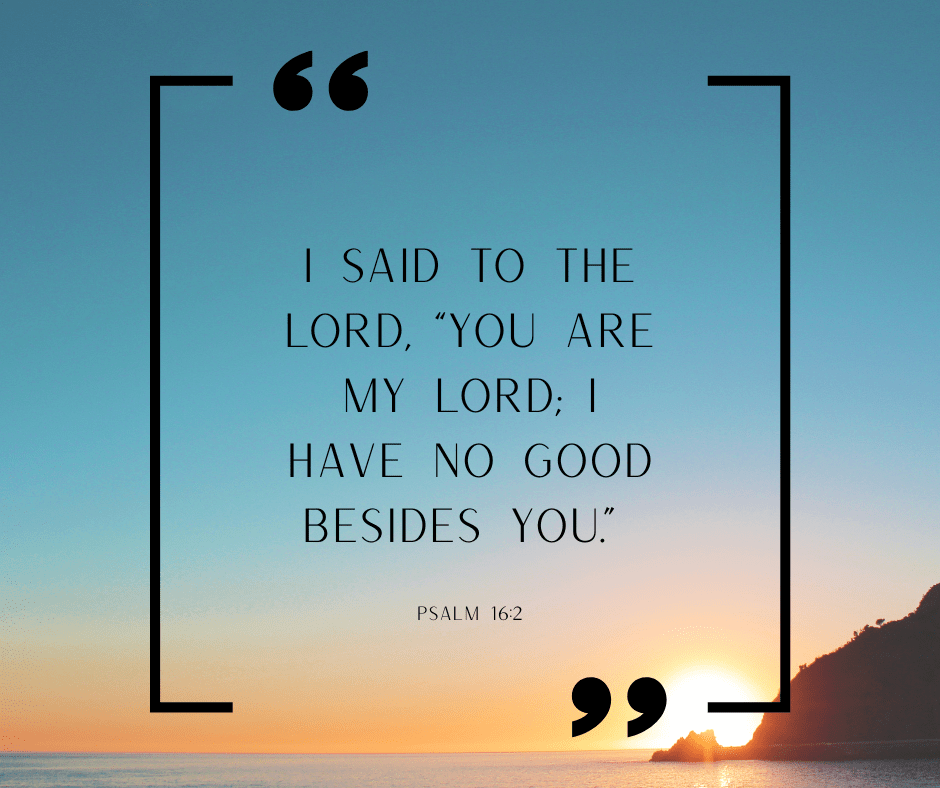
I said to the Lord, “You are my Lord; I have no good besides You.” … The Lord is the portion of my inheritance and my cup; You support my lot. The lines have fallen to me in pleasant places; indeed my heritage is beautiful to me (verses 5-6).
David had learned to trust God’s timing and to focus on the joy and goodness of simply walking in His presence. He knew that whatever God had planned for him would be good and worth the wait. Even in turbulent circumstances, he could say, “the lines have fallen to me in pleasant places.”
Where have the lines fallen for you?
Are you walking in the assurance of God’s will while facing opposition?
Find your refuge in the Lord. Meditate on His Word and keep Him in the forefront of your mind and heart as He walks with you. He is our inheritance, and we have no good besides Him.
 The Way Of The Word
Great thoughts, emphasized in Scripture. God’s Word keeps me focused and offers hope and peace even in the midst of difficult circumstances. Thanks for sharing.
LikeLiked by 1 person
Thanks for reading and responding! Blessings!
LikeLike