
Do you ever feel inadequate to carry the greatest message in the world? As followers of Jesus, we bear both the privilege and the responsibility, according to scripture. “Go ye into all the world” means our world, where we live and work, and also where God sends us at certain times for specific seasons.
The apostle Paul taught us the proper attitude for this great commission at the beginning of his letter to the believers in Corinth. Although he praised them for their faith and confirmed that they were true followers, as you might know, he would later write some very strong words of rebuke for the sin they had allowed to enter the church. They needed to remember who they were in Christ, what God had done for them, and their obligation to share it with others not only in words, but in the way they lived.
1 Corinthians 1:22-31
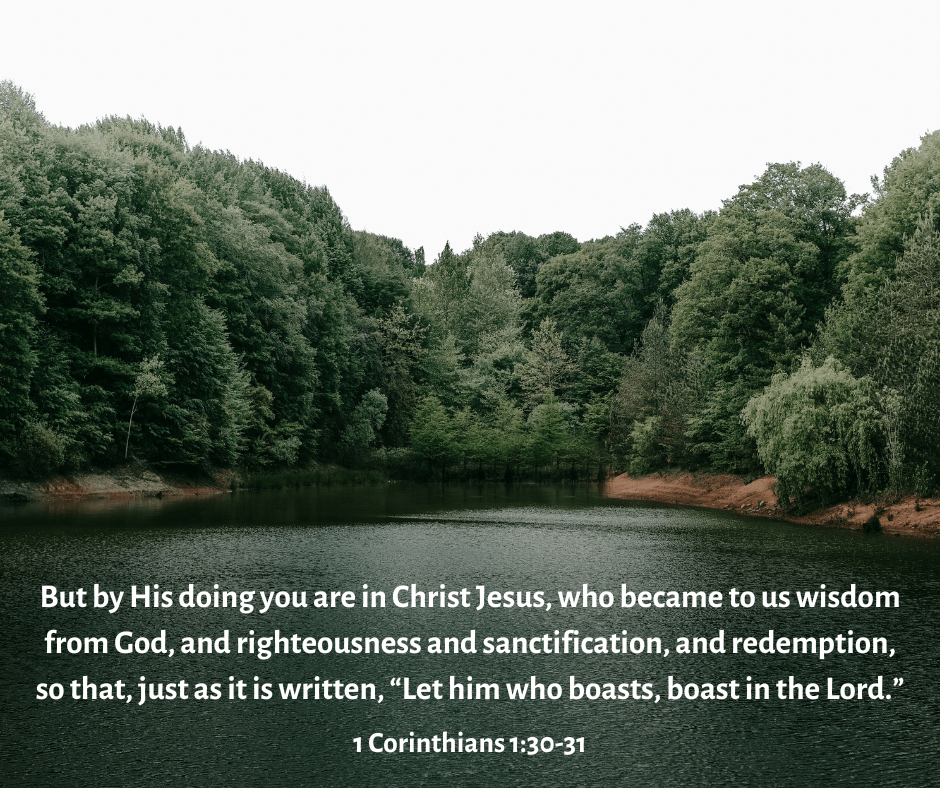
22 For indeed Jews ask for signs and Greeks search for wisdom; 23 but we preach Christ crucified, to Jews a stumbling block and to Gentiles foolishness, 24 but to those who are the called, both Jews and Greeks, Christ the power of God and the wisdom of God. 25 Because the foolishness of God is wiser than men, and the weakness of God is stronger than men. 26 For consider your calling, brethren, that there were not many wise according to the flesh, not many mighty, not many noble; 27 but God has chosen the foolish things of the world to shame the wise, and God has chosen the weak things of the world to shame the things which are strong, 28 and the base things of the world and the despised God has chosen, the things that are not, so that He may nullify the things that are, 29 so that no man may boast before God. 30 But by His doing you are in Christ Jesus, who became to us wisdom from God, and righteousness and sanctification, and redemption, 31 so that, just as it is written, “Let him who boasts, boast in the Lord.”
A few observations:
- Everyone is searching for something (verse 23).
“Jews and Greeks” encompass all people — God’s chosen people, the Jews, and everyone else. The Jews sought signs from God. Jesus faced this same attitude in His time; the Jews were searching for the kingdom of God but missed the King of the kingdom right in front of them (Luke 17:20-21). The Greeks, or Gentiles, sought wisdom and knowledge but failed to recognize the One from whom wisdom comes.
- The answer to everyone’s search is Jesus (verse 24).
Jesus answers our need to see the power of God displayed through His death and resurrection. He fulfills our longing for wisdom by opening our eyes (calling us) to understand and trust the miraculous plan of salvation He established before time began. Who is wiser than God, who solves the dilemma of His own holy and just nature by paying the price of sin and death Himself? Only a wise and powerful God could conceive and carry out such a plan!
- We do not/did not find the answer to our search through human thinking (verses 25-29).
God is wise; we are foolish.
God is strong; we are weak.
Salvation is a divinely revealed plan, and amazingly, God uses foolish and weak humans to both experience and enjoy His salvation and to carry His message. We would expect God to select the noble, the wise, the strong (according to our estimation), yet He turns instead to those whom the world calls weak, foolish—the despised and abased. The key is to abandon our human wisdom and recognize we are all weak and foolish—all in need of a Savior.
- Our search ends in Christ only by His doing and comes with great blessing and reward.
Many can testify about the years they spent pursuing success and achievement through their own efforts, only to find that when they finally “achieved” it, it left them feeling unsatisfied. In sharp contrast, when we respond to God’s call of salvation, we receive blessing upon blessing—both here in the physical world and in the spiritual realm where we dwell with Him (Colossians 3:1-3; Ephesians 1:3). Paul lists four such blessings found only in Christ Jesus. Note how these blessings are to be poured out to others.
Wisdom [sophia]
Wisdom is defined as “devout and proper prudence in intercourse with men not disciples of Christ, skill and discretion in imparting Christian truth; specifically the varied knowledge of things human and divine, acquired by acuteness and experience, and summed up in maxims and proverbs; the knowledge and skill in affairs requisite for the successful defense of the Christian cause against hostile accusations; an acquaintance with divine things and human duties, joined to a power of discoursing concerning them and of interpreting and applying sacred Scripture.
Colossians 1:28, 3:16, 4:5 – We proclaim Him, admonishing every man and teaching every man with all wisdom, so that we may present every man complete in Christ. … Let the word of Christ richly dwell within you, with all wisdom teaching and hymns and spiritual songs, singing with thankfulness in your hearts to God. … Conduct yourselves with wisdom toward outsiders, making the most of the opportunity.
Luke 21:15 – …for I will give you utterance and wisdom which none of your opponents will be able to resist or refute… (Context is that of being persecuted!)
Acts 6:10 – (Regarding Stephen’s presentation of the gospel, just before he was martyred…) But they were unable to cope with the wisdom and the Spirit with which he was speaking.
Righteousness [dikaiosynē]
Righteousness is “the state of him who is as he ought to be; the condition acceptable to God; the doctrine concerning the way in which man may attain a state approved of God; integrity, virtue, purity of life, rightness, correctness of thinking, feeling, and acting.” Vines comments that “the word of righteousness” in Hebrews 5:13 is “probably the gospel, and the Scriptures as containing the gospel, wherein is declared the righteousness of God in all its aspects. Also, that gracious gift of God to men whereby all who believe on the Lord Jesus Christ are brought into right relationship with God.
2 Corinthians 5:21 – He made Him who knew no sin to be sin on our behalf, so that we might become the righteousness of God in Him.
Sanctification [hagiasmos]
Sanctification is the effect of consecration; sanctification of heart and life (Strongs). “Sanctification is thus the state predetermined by God for believers, into which in grace He calls them, and in which they begin their Christian course and so pursue it. Hence they are called “saints” (hagioi). The course of life befitting those so separated.”
According to Vines, sanctification must be learned from God as He teaches it by His Word (1 Thessalonians 4:4; John 17:17,19), and it must be pursued by the believer, earnestly and undeviatingly (1 Timothy 2:15; Hebrews 12:14). He asserts that the holy character, hagiosune, is not vicarious, i.e., it cannot be transferred or imputed. Instead, it is an individual possession, built up, little by little, as the result of obedience to the Word of God, and of following the example of Christ.
In Christ, we are made righteous, and through the Holy Spirit and the Word of God, we are sanctified…able to grow in righteous actions, words, and deeds that testify to the gospel. At the end of this passage, Paul says, “Let him who boasts, boast in the Lord.” What better motivation to live a life pleasing to God, so that others may see the transformation and give glory to God?
Titus 2:7-8 – In all things show yourself to be an example of good deeds, with purity in doctrine, dignified, sound in speech which is beyond reproach, so that the opponent will be put to shame, having nothing bad to say about us.
1 Thessalonians 3:11-13 – Now may our God and Father Himself and Jesus our Lord direct our way to you; and may the Lord cause you to increase and abound in love for one another, and for all people, just as we also do for you; 13 so that He may establish your hearts without blame in holiness before our God and Father at the coming of our Lord Jesus with all His saints.
Redemption [apolytrōsis]
Redemption is a “releasing effected by the payment of ransom.” The literal read is apo, “from,” lutron, “a price of release.” Our redemption is two-fold. First, it is forgiveness and justification, “redemption” as the result of expiation, deliverance from the guilt of sins. We are redeemed (released) from the punishment of our sins, Christ having taken our punishment upon Himself, and granted us freedom.
Romans 3:24 – …Being justified as a gift by His grace through the redemption which is in Christ Jesus.
Ephesians 1:7 – In Him, we have redemption through His blood, the forgiveness of our trespasses, according to the riches of His grace.
We have not yet experienced the second part of our redemption, which comes either upon our death and release from this world, or when Christ returns for His people. On that day, we shall be redeemed (released) from the presence and power of sin.
Romans 8:23 – And not only this, but also we ourselves, having the first fruits of the Spirit, even we ourselves groan within ourselves, waiting eagerly for our adoption as sons, the redemption of our body.
Ephesians 1:13-14 – In Him, you also, after listening to the message of truth, the gospel of your salvation—having also believed, you were sealed in Him with the Holy Spirit of promise, who is given as a pledge of our inheritance with a view to the redemption of God’s own possession, to the praise of His glory.
Luke 21:28 – But when these things [the signs of Christ’s return] begin to take place, straighten up and lift up your heads, because your redemption is drawing near.
What’s our takeaway?
The things we enjoy as followers of Jesus are not just ours to hoard. As we walk in wisdom and sanctification, made righteous and redeemed, let us speak of these things to a searching world. May we offer up our foolish and weak hands and hearts to the glory of God and tell others what He’s done for us.
 The Way Of The Word
thank you very well written very encouraging
LikeLiked by 1 person
Thanks. Such a rich passage! You are an encouragement to me! 🙂
LikeLiked by 1 person