
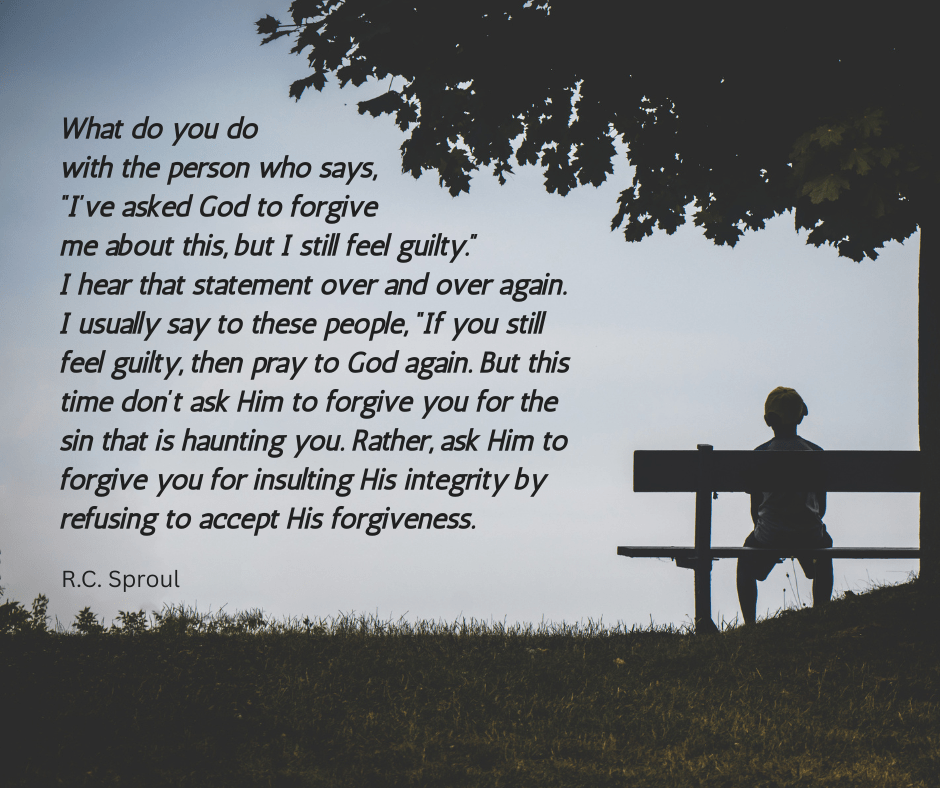
In last week’s blog, we learned that the righteous person, the one who has been saved by faith in God’s Son, Jesus Christ, is no longer guilty of sin. This is true according to scripture.
So, why do we so often feel guilty about our sins—both past and present? If Jesus has set us free, what is the secret to living in and experiencing that freedom?
Guilt affects us in two ways. First, it is the condition of the unrepentant man or woman who bears responsibility for their sins. Second, it is the feeling of shame and remorse that arises when confronted—or reminded—of our sin. Salvation removes the condition, and as we grow in sanctification, we can be freed from the feelings.
Leviticus 5 describes the guilt offerings prescribed in the laws given to Moses. Notably, the offerings covered both intentional and unintentional sin. A person can sin thoughtlessly, “and it is hidden from him,” and “when he comes to know it,” he will be guilty. The sin offerings covered a person if they were unaware of their sin, but once they realized they had sinned, they were guilty.
The first step toward living in freedom from guilt is confession. We must acknowledge our sin and agree with God about it.
Leviticus 5:5 – So it shall be when he becomes guilty in one of these, that he shall confess that in which he has sinned.
Psalm 32:5 – I acknowledged my sin to You, and my iniquity I did not hide; I said, “I will confess my transgressions to the Lord”; and You forgave the guilt of my sin. Selah.
That sounds easy, doesn’t it? Yes, I agree that as we grow in our faith and love for the Lord, we should more readily recognize our sin and seek His forgiveness. Guilt is a good thing when it prompts us to cry out to God for renewed cleansing and restored fellowship. A willingness to confess sin is the mark of a true follower.
But the fact remains that we can still feel guilty for our past sins and defeated by our present ones, even after confessing them. Our enemy, the devil, is an accuser. He delights in bringing up our failures and whispering all manner of lies.
“If you were really saved, you wouldn’t have done that.”
“You ought to be ashamed.”
“You’ll never have victory over that sin.”
“God is disappointed in you.”
“Keep it up. God is going to deny He knows you.”
That’s when we need to move forward to step two.
The second step toward living in freedom from guilt is obedience. We must continue to grow in our goal of listening to and obeying the Word of God as the Holy Spirit teaches us.
1 John 3:9,18 – No one who is born of God practices sin, because His seed abides in him; and he cannot sin, because he is born of God. Little children, let us not love with word or with tongue, but in deed and truth.
This verse explains why Christians do not make a practice of sin. We have a new nature; God’s seed (the Spirit of Christ) abides in us. He appeared to take away sins, and in Him there is no sin (1 John 3:5). If we want to enjoy the guilt-free life God intends, we must avoid sin at all costs. If we sin, we confess it immediately and repent—we turn away from it—and walk forward in obedience.
The writer of Hebrews urges us to keep striving to avoid sin and to obey God. In a lesson on endurance amid God’s discipline, he says, “You have not yet resisted to the point of shedding blood in your striving against sin” (Hebrews 12:4). In other words, it hasn’t killed you yet, so get up and keep walking… keep obeying… keep listening and learning as God disciplines and teaches you, shaping you more and more into the image of His Son. The more we desire to “look like Jesus,” the more God will show us our sin.
Finally, the third step to living in freedom from guilt is to trust what God says more than what our hearts say.
1 John 19-21 – We will know by this that we are of the truth, and will assure our heart before Him in whatever our heart condemns us; for God is greater than our heart and knows all things. Beloved, if our heart does not condemn us, we have confidence before God…
“We will know by this” refers to verse 18, where John says we are not to “love with word or with tongue, but in deed and truth.” In other words, our lives match our words. We are not simply professing Christ; we possess Christ in our new nature, which leads us away from sin. Abhorrence of sin is a sign that we are “of the truth.”
If we are confessing sin when God reveals it and striving to live in obedience, we can trust that God is “greater than our heart,” even when our heart still feels the sting of guilt.
We trust God when He says we are forgiven.
We trust God when He says He has made us holy.
We trust God when He says we are cleansed.
We trust God when He says He has justified us.
We trust God when He says He has clothed us in Christ’s righteousness.
We trust God when He says we are His children, adopted forever.
That verse always confused me. If my heart condemns me, doesn’t that mean I’m still guilty? Not in the context of John’s teaching. Yes, by all means, avoid sin. It’s not our nature anymore. But whether we sin knowingly or unknowingly, if we confess and continue to obey, we can trust that God is greater than our hearts, even when our hearts condemn us.
Knowing that God is greater than my heart is incredibly comforting. After all, the human heart, without Christ, is “more deceitful than all else and is desperately sick; who can understand it?” (Jeremiah 17:9). As the psalmist says, we need God to examine our hearts and show us what He sees, not what we see.
Psalm 139:23-24 – Search me, O God, and know my heart; try me and know my anxious thoughts; and see if there be any hurtful way in me, and lead me in the everlasting way.
Do you struggle with feelings of guilt?
Jesus came to set you free. Let God take care of the condition of your guilt by confessing your sins and receiving forgiveness through faith in Jesus. Determine to love and obey Him with all your heart, mind, soul, and strength. When you’ve done that, trust that He is greater than your heart!
***
After writing this blog, I felt I needed to check my theology and interpretation of the very important phrase, “God is greater than our hearts.” To that end, I offer John MacArthur’s commentary on this passage.
Those who have been justified by faith are at peace with God (Rom. 5:1) and enjoy the peace of God (Phil. 4:7). Nevertheless, a believer may experience unnecessary guilt as his heart condemns him. But there is a higher court than the human heart, for God is greater than our heart and knows all things. If He has declared believers righteous in Christ, then they are righteous. Thus Paul wrote, “There is therefore now no condemnation for those who are in Christ Jesus” (Rom. 8:1). And no one can ever separate them from the saving love of God in Christ (8:31-39). He sees believers’ greatest, most profound failures, and He knows far more about their weaknesses than even their consciences do (Pss 1:6; 103:14; 139:1-6; Prov. 24:12; Heb. 4:13). Yet God has forgiven those who by faith in Christ have been adopted into His family (Rom. 8:14-17). Moreover, He is at work in their hearts, continuing to cleanse them from the sin that still lingers there (Phil. 2:12-13). He looks beyond the remaining sin and sees the holy affections He has planted in them that demonstrate the transformed natures of His children. Therefore even when overwhelmed by their sinfulness believers can say with Peter, “Lord, You know all things; You know that I love You” (John 21:17; cf. Rom. 7:14-25).
 The Way Of The Word