
Romans 9-11 is a foundational passage to study if you want to know what God thinks about the Jews, the nation of Israel. It’s also foundational to understanding the sovereignty of God, juxtaposed against His mercy, grace, and compassion. Perhaps most importantly, it reminds us not to hold so tightly to one of God’s attributes or character traits that He has revealed in scripture, to the exclusion of others that we would prefer to ignore.
In Romans 9, Paul examines God’s right and authority to choose whom He will call, both to salvation and to whatever purposes He decrees for our lives. The “big picture” issue is His plan for two people groups: Jews and Gentiles. Some were saying (and still say today) that God has turned away from the Jews and replaced them with the Gentiles as His chosen people. Paul argues strongly that this is not the case. Yes, the Jews have been set aside for a time until God has fully redeemed His people from the Gentile nations, but at a point in the future, He will once again turn His attention to His beloved Jewish nation, and a remnant will be saved.
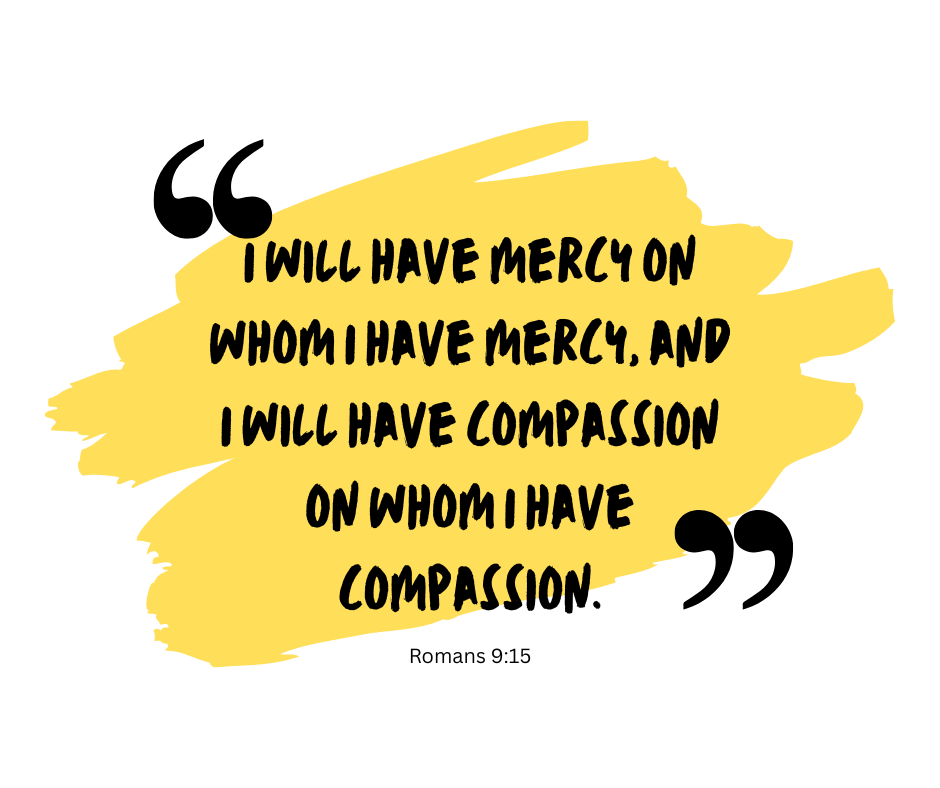
There are some hard things to accept and believe about God in these chapters. God says, “I will have mercy on whom I have mercy, and I will have compassion on whom I have compassion” (9:15). “He has mercy on whom He desires, and He hardens whom He desires” (9:18). Using Jacob and Esau as examples, Paul says, “though the twins were not yet born and had not done anything good or bad, so that God’s purpose according to His choice would stand, not because of works but because of Him who calls … the older shall serve the younger … and Jacob I loved, but Esau I hated” (9:11-13).
Paul goes on to say, “It does not depend on the man who wills or the man who runs, but on God who has mercy” (9:16). He gives the example of Pharaoh, who hardened his own heart, yet whose heart was also hardened by God at first (9:17; Exodus 4:23, 7:23). God can choose as He wills, yet there is no injustice. He is the molder, the creator, and the potter, and has the right to do as He pleases with those He creates.
This is a hard thing and goes against everything in our human nature. Our initial reaction is, “That’s not fair!” Yet God had a purpose in dealing with humanity this way. His actions show that we can neither exclude ourselves from His grace and mercy by being “too bad” nor earn it by being “good.” Salvation depends completely on His mercy.
So, what’s the point? What hope do we have? If we can’t “choose God” because we have some smidgen of goodness within ourselves, how can we trust and believe in what seems to be the “capricious whims” of God?
Well, keep reading. Consider these words in Romans 10:1-13.
Brethren, my heart’s desire and my prayer to God for them is for their salvation. For I testify about them that they have a zeal for God, but not in accordance with knowledge. For not knowing about God’s righteousness and seeking to establish their own, they did not subject themselves to the righteousness of God. For Christ is the end of the law for righteousness to everyone who believes. For Moses writes that the man who practices the righteousness which is based on law shall live by that righteousness. But the righteousness based on faith speaks as follows: “Do not say in your heart, ‘Who will ascend into heaven?’ (that is, to bring Christ down), or ‘Who will descend into the abyss?’ (that is, to bring Christ up from the dead).” But what does it say? “The word is near you, in your mouth and in your heart”—that is, the word of faith which we are preaching, that if you confess with your mouth Jesus as Lord, and believe in your heart that God raised Him from the dead, you will be saved; for with the heart a person believes, resulting in righteousness, and with the mouth he confesses, resulting in salvation. For the Scripture says, “Whoever believes in Him will not be disappointed.” For there is no distinction between Jew and Greek; for the same Lord is Lord of all, abounding in riches for all who call on Him; for “Whoever will call on the name of the Lord will be saved.”
We can have a “zeal” for God (a desire to reach Him or understand Him), but that zeal is useless unless it is combined with knowledge and acceptance of how God intends to make us righteous—through His Son, Jesus Christ. Paul quotes Deuteronomy 30, where Moses speaks to the rebellious nation of Israel just before they enter the Promised Land after forty years of wilderness wanderings. He warns that their desire to “make their own rules” and approach God in their own righteousness would lead to much pain and suffering. They (and we) are not so righteous as to go up to heaven and bring Christ down or raise Him from the dead in our own power. That’s arrogance. But if and when they return to God on His terms, He would forgive them fully and restore them with a blessing.
Paul goes on to say that God has already declared that WHOEVER calls on His name will be saved. WHOEVER believes in Him will not be disappointed (Isaiah 28:16; Joel 2:32).
The hard thing about God is that He can save whomever He chooses.
The good thing about God is that He desires for all to be saved.
2 Peter 3:9 – The Lord is not slow about His promise, as some count slowness, but is patient toward you, not wishing for any to perish but for all to come to repentance.
John 3:16 – For God so loved the world, that He gave His only begotten Son, that whoever believes in Him shall not perish, but have eternal life.
1 John 2:2 – …and He Himself [Jesus Christ] is the propitiation for our sins; and not for ours only, but also for those of the whole world.
Romans 10:8-10 – But what does it say? “The word is near you, in your mouth and in your heart”—that is, the word of faith which we are preaching, that if you confess with your mouth Jesus as Lord, and believe in your heart that God raised Him from the dead, you will be saved; for with the heart a person believes, resulting in righteousness, and with the mouth he confesses, resulting in salvation.
Many reject salvation and will die in their sins (living and dying by the law they claim to fulfill) because of their pride. It is humbling to say to God, “You have the right to do what You will. You are God, and I am not.” As scripture vividly illustrates through the lives of many who go down this path, each time we reject the truth, our hearts grow a little harder, and our estimation of our own righteousness increases, but it is a righteousness that will lead us astray. There is none righteous, no not one (Romans 3:10).
The truth isn’t hard to find. The word is near you, in your mouth and in your heart. That feeling deep down that perhaps God is right… that conviction within your conscience about your sin… that longing for something you can never seem to find… is very likely the Holy Spirit of God calling you to come to God on His terms.
Humble yourself to accept the hard things about God, for it is in those very truths we will find the ultimate expression of His goodness.
 The Way Of The Word