
How strong are your opinions? My mama taught me, “Opinions are like belly buttons: everybody has one!” Did you know the Bible talks about opinions?
Romans 14:1 – Now accept the one who is weak in faith, but not for the purpose of passing judgment on his opinions.
The NASB translates the Greek noun dialogismos as “opinions.” The literal translation of the verb form of this word is “to reason through,” so we could say our opinions are the conclusions we reach after reasoning within ourselves. In Romans 14 and 15, Paul teaches followers of Jesus how to treat one another when our opinions threaten to divide us.
How unified do we need to be? Can I think differently from you on spiritual issues?
The first thing to note is that Paul is speaking to believers whose foundation is built on the Lord Jesus Christ. These issues are about family matters, not a plea to conform to worldliness or ungodliness. Opinions are secondary to our unity in Christ.
Romans 15:5-6 – Now may the God who gives perseverance and encouragement grant you to be of the same mind with one another according to Christ Jesus, so that with one accord you may with one voice glorify the God and Father of our Lord Jesus Christ.
The disagreements Paul is describing are not about the essential aspects of salvation. The group of people he wrote to had already accepted that Jesus is the promised Messiah, the Son of God who was crucified, buried, and rose again to bring salvation to both Jews and Gentiles. In this context, he is addressing two groups. Some of the Jews who had believed by faith were convinced in their hearts that they needed to follow the laws regarding clean and unclean foods, drinks, and the observance of feasts and holy days. Meanwhile, the Gentiles, who had no history with the laws of Moses, saw no reason to worry about what they ate or to be circumcised.
The problem wasn’t the difference of opinion.
The problem was how they were treating each other: passing judgment, showing contempt, and exercising their freedom in Christ, even when it hindered others’ faith.
It’s important to observe the difference between opinions, or “principles of conscience” as the NASB calls these verses, and sinful thoughts or actions. We can never compromise our biblical convictions or agree to set them aside to “keep the peace” with someone over a sinful issue. For example, we can’t “agree to disagree” on issues like homosexuality, abortion, adultery (sexual relationships outside marriage), or fornication (sexual relationships while unmarried). If the Bible calls it a sin, the matter is settled, and our opinions are irrelevant. But there is great freedom in Christ on many other issues, and in those, we need to take heed to the wisdom God gave Paul so that we model Christ’s attitude and keep the focus on Him, rather than ourselves.
Here are five key principles to remember as we handle disagreements about secondary preferences in our worship of the Lord Jesus.
Principle #1 – Avoid a superior attitude towards those who have different opinions.
Romans 14:1,3 – Now accept the one who is weak in faith, but not for the purpose of passing judgment on his opinions. … The one who eats is not to regard with contempt the one who does not eat, and the one who does not eat is not to judge the one who eats, for God has accepted him.
The word “judgment” comes from a Greek word meaning “distinguishing between good and evil.” To regard with contempt is to despise. Paul tells us to lose the attitude that causes us to look down our noses at others simply because they have a different idea or preference. It is to elevate our own opinions as “righteous” and see others as less than or even evil. In other words, “You must not be as spiritual as I am, since you don’t see things the way I do!”
Principle #2 – Remember that we are responsible to give account to our Lord and Master, Jesus, not each other.
Romans 14:10-12 – But you, why do you judge your brother? Or you again, why do you regard your brother with contempt? For we will all stand before the judgment seat of God. For it is written, “As I live, says the Lord, every knee shall bow to Me, and every tongue shall give praise to God.” So then each one of us will give an account of himself to God.
Earlier, Paul says, “Who are you to judge the servant of another? To his own master he stands or falls” (Romans 14:4). While the saved will not be judged for their sins, all followers of Jesus will stand before God and give an account for their lives. I will only answer for myself; thank goodness, I don’t have to answer for anyone else! God is the only one sitting in the place of a righteous judge, so there’s no need for us to judge each other now.
Principle #3 – If we’ve sought God’s heart and there are no scriptural restrictions, we are free to follow our personal convictions.
Romans 14:22-23 – The faith which you have, have as your own conviction before God. Happy is he who does not condemn himself in what he approves. But he who doubts is condemned if he eats, because his eating is not from faith; and whatever is not from faith is sin.
This principle naturally follows the previous one. Perhaps there are occasions when we need to say to one another, “You’re not the boss of me!” If God has shown you in scripture that something is not wrong, then live in freedom and be happy. But if you’re not sure, step back from it until God shows you what He wants you to do. You don’t want to violate your conscience. The goal is a tender heart sensitive to the leading of the Holy Spirit.
A good example of this is social drinking. I have a personal conviction that I do not drink. I grew up in a culture where any kind of alcohol consumption was frowned upon and seen as a sin. While I know now that scripture does not categorically condemn all drinking (it condemns drunkenness), it would offend my conscience to drink. I also feel strongly that the next principle applies here, especially as my husband and I serve in full-time Christian ministry.
Principle #4 – Don’t let your freedom become a stumbling block to another’s faith.
Romans 14:13,21 – Therefore let us not judge one another anymore, but rather determine this—not to put an obstacle or a stumbling block in a brother’s way. … It is not good to eat meat or to drink wine, or to do anything by which your brother stumbles.
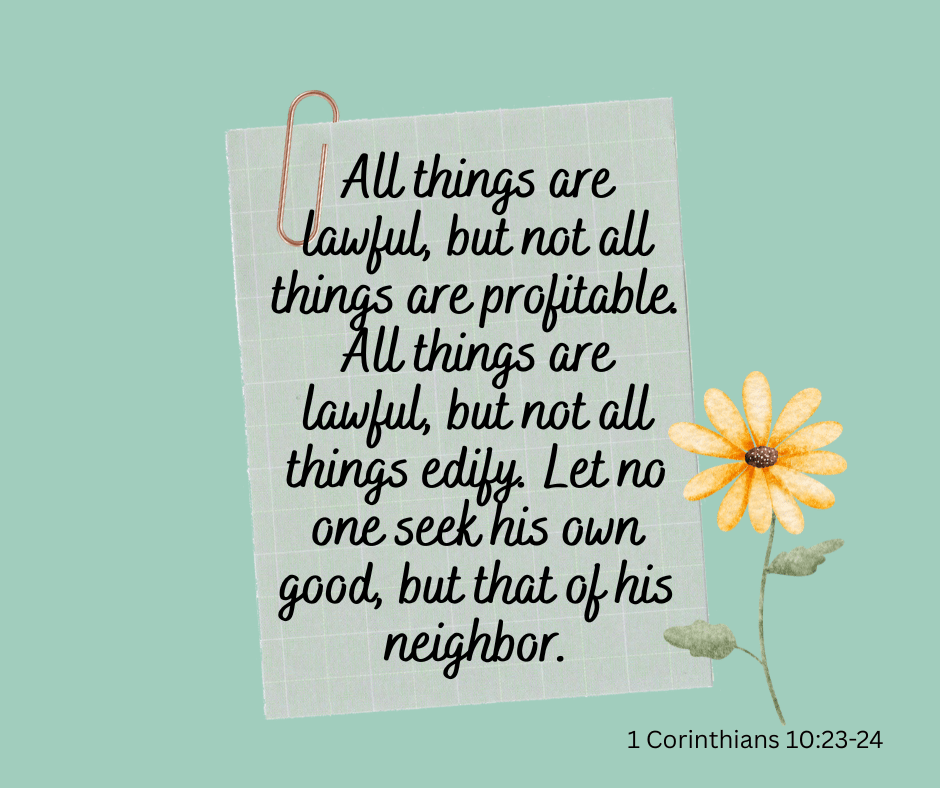
Just because we can do something doesn’t mean we should do it. Stumbling block is the Greek noun proskomma—an object against which one may dash his foot, an obstacle in the way which causes one to fall. Vines defines it this way: the spiritual hindrance to another by a selfish use of liberty. The KJV reads “an occasion to fall.”
In this passage, an example would be a Gentile convert hosting a believing Jewish friend and serving food he knew would be offensive due to the dietary laws his friend followed. The friend would either risk offending his host by refusing to eat or compromise his convictions by participating. Freedom in Christ is a great blessing and privilege but should never be exercised in a way that causes a brother or sister to stumble.
Which brings us to the last principle.
Principle #5 – Pursue peace and build up one another, not live only to please ourselves.
Romans 14:19; 15:1-2 – So then we pursue the things which make for peace and the building up of one another. … Now we who are strong ought to bear the weaknesses of those without strength and not just please ourselves. Each of us is to please his neighbor for his good, to his edification.
Paul provides the ultimate example of the principle of edifying our brothers and sisters. He writes, “For even Christ did not please Himself.” Our Lord Jesus set aside His glory and relinquished His freedom to pay for the sins of all people. He became “a servant to the circumcision” (for the Jews) as well as for the Gentiles, “to glorify God for His mercy” (15:8-9). Nothing about the cross was pleasing to Jesus in His humanity, but He endured great reproach on our behalf (15:3). How much more should we be willing to surrender our pride and our preferences so that others will see Christ in us?
Are your opinions more important to you than the well-being and spiritual growth of your brother or sister in Christ? Paul says it is possible to “destroy with your food him for whom Christ died” and admonishes, “Do not tear down the work of God for the sake of food” (Romans 14:15,20). Instead, we are to walk in love, trusting that God will convince and convict our own hearts of what is best for us, and being humble enough to let Him do the same for the rest of His children.
1 Corinthians 10:31-33 – Whether, then, you eat or drink or whatever you do, do all to the glory of God. Give no offense either to Jews or to Greeks or to the church of God; just as I also please all men in all things, not seeking my own profit but the profit of the many, so that they may be saved.
 The Way Of The Word