
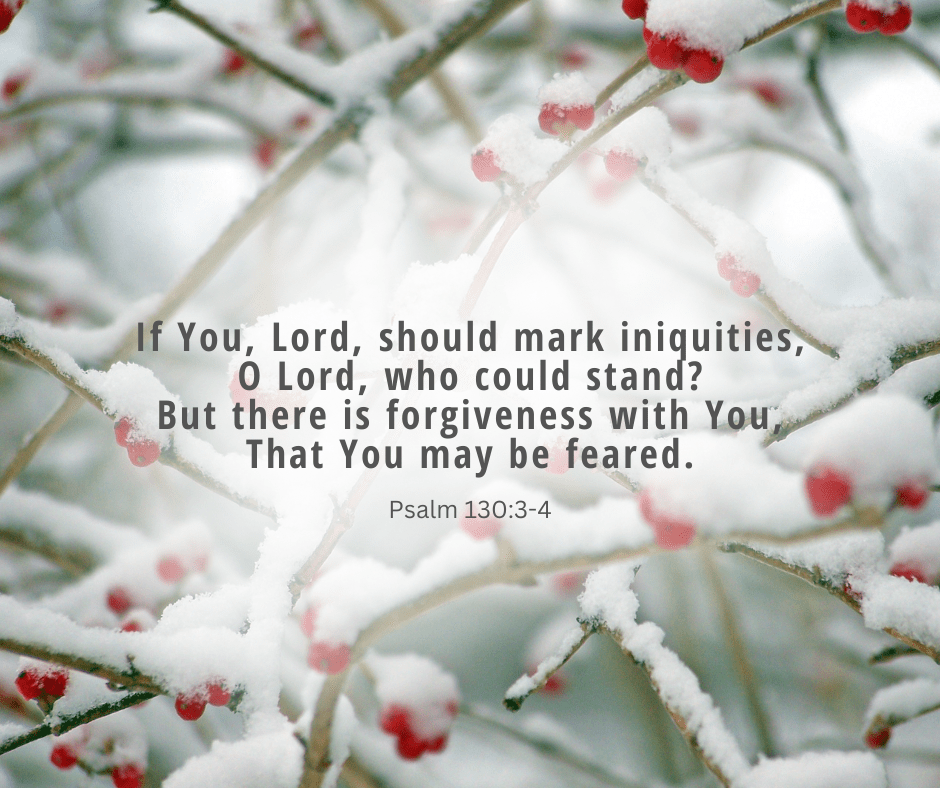
Forgiveness and fear.
What do these two words have to do with each other? They seem to be opposites, yet I find here in Psalm 130 they are somehow connected. Here is the whole psalm, just eight short verses.
Out of the depths I have cried to You, Lord. Lord, hear my voice! Let Your ears be attentive to the sound of my pleadings. If You, Lord, were to keep account of guilty deeds, Lord, who could stand? But there is forgiveness with You, so that You may be revered. I wait for the Lord, my soul waits, and I wait for His word. My soul waits in hope for the Lord more than the watchmen for the morning; yes, more than the watchmen for the morning. O Israel, wait for the Lord; for with the Lord there is mercy, and with Him is abundant redemption. And He will redeem Israel from all his guilty deeds.
The psalmist pictures himself in the depths – a strong visual. He is drowning, lost, and separated; he is in the dark. He cries out to the Lord and reveals what has taken him to the deep darkness in which he struggles: his guilty deeds.
Guilty deeds is the Hebrew ʿāôn, more often translated as “iniquities.” It’s first used in Genesis 4:13, where Cain cries out that his “punishment” is greater than he can bear. I believe this word means more than just the actual sin. It is the weight of the sin – the shame and the guilt – that is crushing our psalmist. It is the recognition that he is guilty of sinning against a holy God.
If you, Lord, were to keep account of guilty deeds, Lord, who could stand?
The psalmist knows what he needs. He needs the light of God’s forgiveness. He waits for the Lord and His word, more, he declares, than the watchmen wait for the morning. In the darkness of the weight of his sin, he longs for the brilliance of the light that he knows will flood his soul when He knows His Creator has forgiven him.
Have you ever had a sleepless night when you longed for the morning? The darkness can seem as though it will never end. How beautiful to see those first rays of the sun begin to pierce the heavy cloak of darkness. Our souls respond to a sunrise because we know we were made to live in the light. This is true physically, but even more so spiritually. We need the Light of Christ to relieve the darkness of our sin.
2 Corinthians 4:6 – For God, who said, “Light shall shine out of darkness,” is the One who has shone in our hearts to give the Light of the knowledge of the glory of God in the face of Christ.
What is the result of forgiveness?
So that the Lord may be feared. The NASB here uses “revered.” The Hebrew word is yārē’, meaning to be fearful, be dreadful, be feared, to cause astonishment or be held in awe, to inspire reverence or godly fear.
On the surface that doesn’t make sense to us. Why would we fear the One who forgives? The worldly view of sin teaches us that, if, indeed sin exists, it’s not a very big deal. If you offend someone, just say you’re sorry and move on. After all, we’re just human. This attitude reveals that we don’t understand sin at all.
In contrast, the psalmist gives us the right picture. Sin is not to be taken lightly or flippantly. No! We are drowning in the dark depths, dying, separated, and lost, without hope. It is only when we truly understand the weight of sin – our guilt – that we cry out for the forgiveness of the One against whom we have sinned. When God reaches down to the depths and pulls us up into the light of His glory, our response is a greater understanding of just how holy He is. He is to be revered and feared. We are astonished and in awe of Him.
This psalm reminds me of Paul’s words to the Corinthian believers. He had rebuked them for their sin, not to intentionally hurt them and bring them sorrow, but to cause them to consider how serious it is to sin against God willfully and knowingly.
2 Corinthians 7:9-10 –I now rejoice, not that you were made sorrowful, but that you were made sorrowful to the point of repentance; for you were made sorrowful according to the will of God, so that you might not suffer loss in anything through us. For the sorrow that is according to the will of God produces a repentance without regret, leading to salvation, but the sorrow of the world produces death.
True repentance leads to forgiveness and salvation, which leads to the right and appropriate fear of God. Regret without repentance will leave us in the depths, and ultimately, death.
What’s our takeaway?
How much do you fear God? The answer to that question will reveal if you’re still in the depths of your sin, or if you’ve experienced His forgiveness.
We are left with a word of encouragement.
Hope in the Lord, for with the Lord there is lovingkindness (mercy) and with Him is abundant redemption. And He will redeem [you] from all [your] iniquities (Psalm 130:7-8).
Wait for the Lord, and for His word of forgiveness. He hears your voice, and His ears are attentive. With Him there is forgiveness, that He may be feared.
 The Way Of The Word
Your words have blessed me this morning. Thank you. I hope that as I read your devotions that I can share them with those in need. 🔆
LikeLiked by 1 person
Glad it spoke to you! ❤️
LikeLike