
Today, I finished reading the book of Genesis, ending with the death of Joseph. Just before he dies, he makes his family promise to take his bones back to Canaan, trusting that God will fulfill the promise made to their ancestor Abraham and give them the promised land.
Joseph is the central character in Genesis 37-50, and his life teaches us many things about perseverance, humility, and success. As I read through his story, here are just a few things that came to mind.
#1 – Joseph learned about God’s sovereignty through adversity.
Joseph was despised by his brothers, sold into slavery, abused by those in power, falsely accused, forgotten by his friends, and mistrusted by those he helped. He had every reason to grow bitter toward God for the things that happened to him through no fault of his own. Yet when all is said and done, he could look back and say, “Am I in God’s place?” He accepted the evil done to him as part of God’s sovereign plans to bring him good. (Genesis 50:19-20)
#2 – Joseph learned to forgive.
Joseph’s willingness to forgive his brothers is the brightest example. He tested their hearts, not revealing himself immediately but asking questions and arranging circumstances to see if their attitudes had changed and matured. Yet even in that, he held no animosity toward them. He saw God’s hand in putting him in a position of responsibility and power so that his family could be preserved.
#3 – Joseph learned to work hard.
Some of Joseph’s defining character traits include the integrity, honesty, and diligence he demonstrated in every situation. From slavery to prison to the palace—regardless of where he was or what his role entailed, he worked for the benefit of his masters and employers. He understood that their success was his own success.
How could Joseph not only survive what life threw at him but also thrive in it? What was the secret to his success? I believe it lies in the names he gave his two sons.
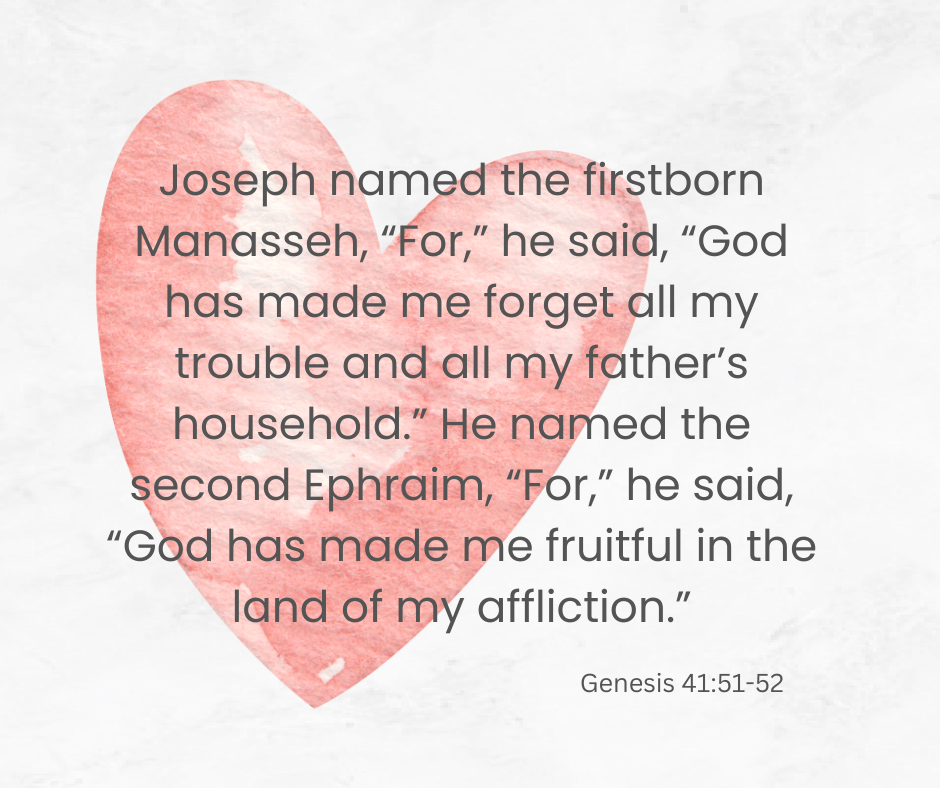
Genesis 41:51-52 – Joseph named the firstborn Manasseh, “For,” he said, “God has made me forget all my trouble and all my father’s household.” He named the second Ephraim, “For,” he said, “God has made me fruitful in the land of my affliction.”
God has made me forget all my trouble and all my father’s household.
God has made me fruitful in the land of my affliction.
Now we know that Joseph didn’t genuinely forget his family. When they were finally reunited, he wept profoundly. Yet, he was able to move forward and not let the dysfunctional events of his childhood ruin the rest of his life. God granted him the strength to leave it behind and focus on the blessings he was experiencing in his present life.
Let’s be honest. All families could be classified as “dysfunctional” in some way. No parent is perfect, and children are innately rebellious. Sibling rivalry is almost inevitable, and despite our best efforts, mistakes are made as we navigate family relationships. Joseph’s story encourages us to trust that God has a plan and a purpose and will bring good out of what people intend for evil.
Joseph also recognized the blessings that God had wrapped in affliction. Each difficult moment taught him something about himself, the nature of people, and the value of honest, humble work. Joseph didn’t attain an exalted position—second in the land to Pharaoh—through his own scheming. He simply kept his head down, worked hard, maintained his integrity, and experienced the blessing of God’s favor, even in the toughest circumstances.
What in your past are you allowing to ruin your future? What difficult circumstance has God strategically arranged for your benefit that feels unbearable and may be causing bitterness or unforgiveness?
Consider Joseph’s example. Let go of the past and acknowledge God’s role in your present. This is the only way to ensure a successful future, not just for you, but also for your descendants.
 The Way Of The Word
thank you
LikeLike