
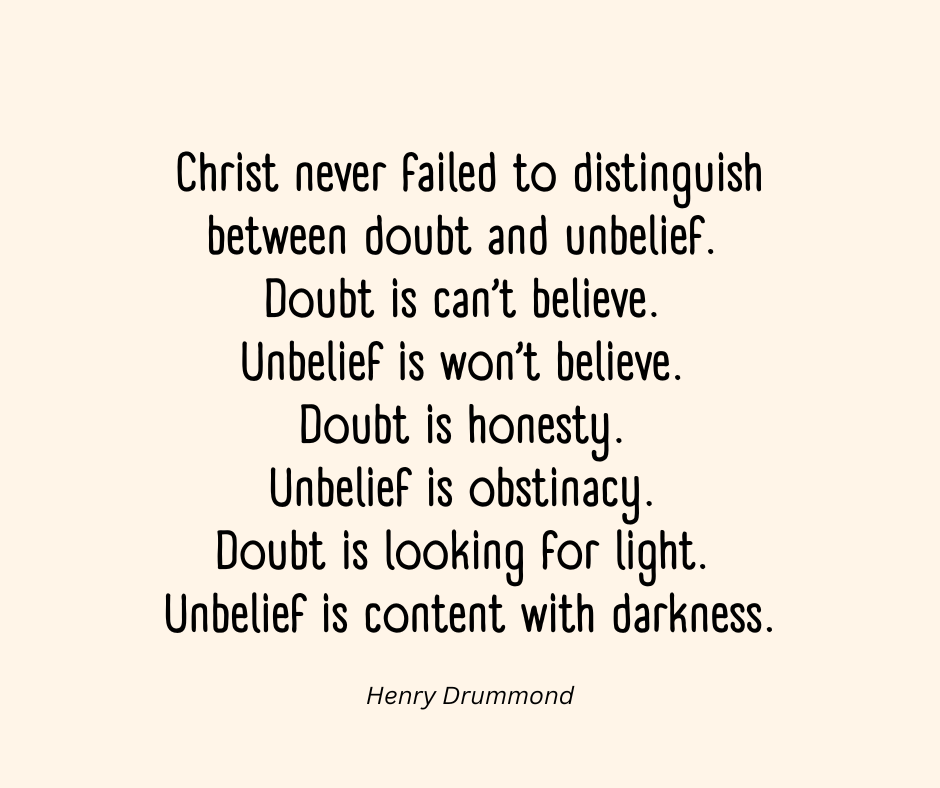
I am working on an idea for a book to help those who may be doubting their faith to the point of redefining core beliefs or deconstructing what they have been taught as truth. I’ve got a long way to go, but over the next few weeks, I plan to share some of what I’ve written. I’d love your feedback if it’s helpful. Today’s post is from the introduction to the book.
***
I distinctly remember the moment I recognized the concept of legalism. It wasn’t the first time I encountered this idea, having grown up in a very conservative, albeit biblical and loving, Independent Baptist Church. But to a child, all things are normal until we know differently. What some would consider unnecessary became natural to me.
A boy’s hair cannot touch his ear.
A girl cannot wear slacks.
Movie theaters should be avoided.
Boys and girls cannot swim at the same time.
Secular music is a tool of the devil.
Only one scripture version is considered a “real” Bible.
As a generally compliant child, I shunned conflict. I saw little to gain by intentionally disobeying the authority of my parents, church, or God. I fully believed and embraced the Bible teaching I received and came to faith in Jesus at the young age of seven. I enjoyed a sheltered and secure childhood; I had no reason to question.
Around the age of fifteen, I made plans to join my youth group for a hayride. The youth pastor’s secretary distributed flyers to the group with the necessary details, including one that stated that girls should plan to wear dresses. In the late 1970s, a girl with pale white skin would never be caught wearing a dress without a pair of nylons in the appropriate shade of “tan.” I’m quite sure our youth pastor and his wife knew that most girls would be wearing these if required to wear a dress. This didn’t seem to be an issue for them, but my mother had a different perspective: common sense. Common sense tells us that pantyhose and hay are not a good mix. A pair of jeans or slacks would be far more comfortable and far more appropriate for climbing up and down in a hay wagon. To that end, she told me I would not be attending in a dress.
At this moment, legalism became personal to me.
I wanted to go on that hayride.
I did not want to be singled out for wearing pants.
In the end, I decided to do the brave thing—the commonsense thing—and wear pants. But first, I called my best friend and convinced her to buck the system with me! Filled with trepidation (and a bit nauseous) on the ride to the church, I imagined I would be shamed and embarrassed. I refused to get out of the car until my friend drove up. As I walked to her car window, I said, “You’d better be wearing pants!” And she was.
A few years later, I found myself at a Christian college with thousands of other students. Imagine my surprise when I discovered that true followers of Jesus are not all Independent Baptists! I met Presbyterians, Methodists, Lutherans, Episcopalians, Freewill Baptists, Southern Baptists, and Catholic students who loved the Lord and sought to be diligent students of God’s Word.
I soon realized that the length of a person’s hair, the presence of a tattoo (or lack of), the style of clothing, or the type of music they prefer does not necessarily determine the depth of their faith. It dawned on me that perhaps not everything I had been taught was true.
At this point in my life, I had three choices.
I could continue believing everything I had been taught, whether or not it proved to be based on biblical truth and live my life according to what others said about God, Jesus, the Scriptures, and the Christian faith.
Or I could consider myself duped by a lot of well-meaning people and reject everything. After all, if some of it wasn’t true, was any of it?
Or I could begin to examine for myself what truly constitutes a biblical worldview and authentic, Christ-centered faith, accepting others’ interpretations only when I am convinced they accurately represent Scripture.
I know that many who are reading this may have faced far more serious encounters, not only with faulty theology like legalism (the religion of good works) and liberalism (the religion of satisfying our flesh) but also real abuse from those who claim to represent Christ. Nevertheless, we all have the same choices I had when I began to realize that humans often distort, misrepresent, and even corrupt what God intends for good.
“Christianity is not built on the performance of Christians. Rather, it is built on the person of Christ.” This is a good reminder when we are disappointed by those who claim the name Christian. It’s not uncommon to feel disillusioned by the people who taught us important life lessons, particularly regarding spiritual truths. No one possesses all knowledge. No one is perfect. Any true follower of Jesus is simply doing their best to understand who God is, what he desires, and how to live a life that pleases him. We will inevitably make mistakes and miss the mark on some things.
It’s also inevitable that every believer will have questions about God as they grow in faith. The more we discover about him, the more we realize how little we know and understand about our inscrutable, transcendent God. In fact, it’s necessary and healthy to wrestle with our questions. My daughter says it better: “To be honest, if you don’t have a tension that is hard for you to hold in Christianity, I do not think you’ve truly encountered the fullness of Scripture or the character of God. We aren’t the center, and God is not just a better version of us.”
However, a vast difference exists between asking sincere questions and abandoning faith as toxic or unnecessary. Today, the idea of “deconstructing faith” is not just an idea but a movement. A quick search on social media for #deconstructing or #exvangelical reveals numerous influencers who not only encourage questioning what you’ve been taught but also advocate for discarding the entire notion of religion or faith. While this isn’t anything new, its impact is stronger than ever, reaching young, impressionable hearts and minds. Our adversary, Satan, is attacking and undermining the faith of entire generations at a crucial moment when their faith is being formed and becoming personal.
Perhaps you’ve already deconstructed your faith. At some point, you started to wonder if the people you trusted had lied to you. Perhaps your experience with the God of scripture hasn’t matched what others said it should be. You have questions that no one seems able to answer. You feel that God has let you down or that he hasn’t come through at the most critical times and for the most significant reasons.
If God is all-powerful, why doesn’t he eradicate all evil?
If God can heal, why do good people— and young people—die?
If God is just, why is there so much suffering in the world?
If God knows everything, why doesn’t he prevent bad things from happening?
And what about all those so-called miracles and fantastic stories in the Bible?
I believe God can answer our questions if we give him the opportunity and approach him with an open mind and a heart willing to learn and listen. I believe he can settle our doubts and reveal himself to us. I believe we can know the truth and possess the wisdom and discernment to separate fact from fiction and man-made ideas from God-inspired reality. And I believe the gospel according to Jesus, accepted as truth with nothing added or subtracted, is the answer to all our doubts, disillusionments, and despair.
I love the game Jenga. Its premise is simple, and even a child can play. The name “Jenga” comes from the Swahili word “kujenga” which means to build. Players stack fifty-four blocks in perpendicular layers. They pull one block at a time from the tower, replacing the block on top. This causes the structure to grow more and more unstable until it finally comes tumbling down. Sadly, the person who pulls out the final block is the loser.
Jenga is just a fun game, except when we play it with our faith. Each block represents something you’ve been taught about God. It’s built over the course of a lifetime—placing one block on another. Along the way, most of us find a few blocks that don’t fit. We either discover they’re not true (so they should be discarded) or we just don’t like them, so we pull them out without considering how it might affect our entire belief system. If we’re not careful, we will continue to deconstruct until it all comes crashing down. And we’re the loser for it.
How do you build back?
How do you determine what does or doesn’t belong in your worldview?
How do you lay a new foundation of spiritual beliefs?
Is reconstruction possible after deconstructing our faith?
If you’ve found yourself at the bottom of the pile, come with me as we step out of the mess we’ve made. Let’s talk about what we can and can’t discard in our pursuit of true faith and what it really means to build our lives on a biblical foundation. Most importantly, let’s reacquaint ourselves with the God of the Bible and ask him to help us find redemption in the rubble of religion.
 The Way Of The Word
Oh my goodness Sheila- I identified with this so much. God is leading you to write words that will be life changing for so many. I can’t wait for the completion- keep writing sister. Love you- Kathie
Sent from my iPhone
LikeLike